See what a schema migration breaks before it runs
Schemity's impact analysis reads a pending schema change, or a migration file written anywhere else, against your live PostgreSQL, MySQL, MariaDB, SQL Server or SQLite database, and tells you what it costs before anything runs: the rows it loses, the statements that will fail on existing data, the tables it rewrites, how long it holds back reads and writes, and every view, trigger and function in the way. Each finding carries a number from the live catalogue. Nothing is executed; a count runs only when you ask for one.
2 weeks, no credit card. macOS, Windows, Linux.
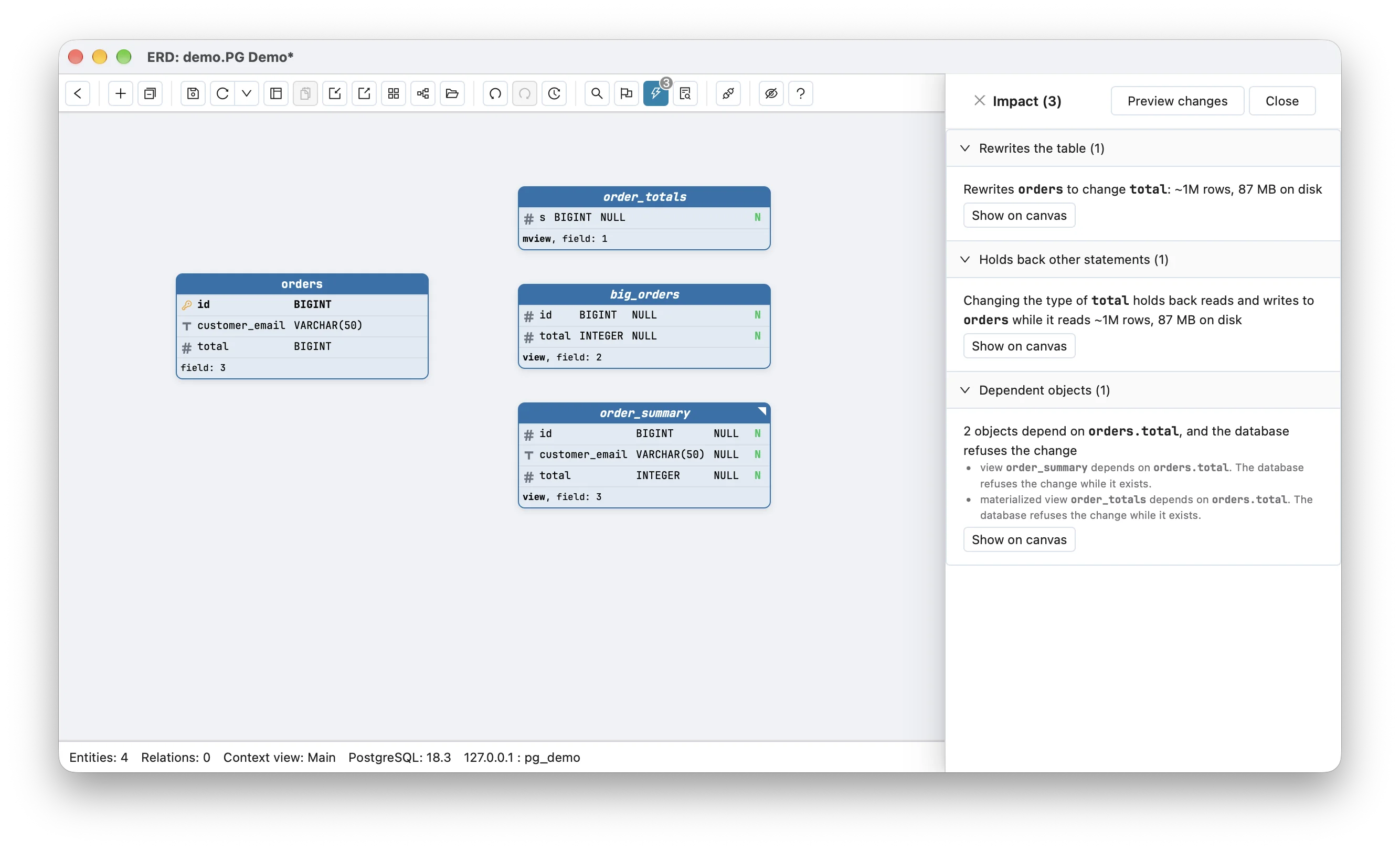
ALTER TABLE orders ALTER COLUMN total TYPE bigint;
- Rewrites the table
- Rewrites orders to change total: ~1M rows, 87 MB on disk
- Holds back other statements
- Changing the type of total holds back reads and writes to orders while it reads ~1M rows
- Dependent objects
- 2 objects depend on orders.total, and the database refuses the change: view order_summary, materialized view order_totals
From a real run on PostgreSQL 18.3. PostgreSQL itself names only the first view.
What does impact analysis report?
Findings are grouped by what they cost, in this order. They are facts with numbers, never severity levels, and the report never tells you not to proceed.
Loses data
A dropped table or column, or a type change that cannot keep every value, such as text to integer or a narrower varchar.
Can fail on existing data
SET NOT NULL over nulls, a NOT NULL column with no default, a unique key over duplicates, a foreign key over orphan rows, a check the rows were never tested against.
Storage engine
MySQL only: a foreign key on a MyISAM table is accepted and silently not stored, and one referencing such a table is refused.
Rewrites the table
A type change the engine performs by copying the table, or a new column whose default is computed for every row, with the row count and size on disk.
Holds back other statements
Whether writes wait, or reads and writes, while the statement builds an index, checks a key or NOT NULL, or changes a type.
Dependent objects
Views, materialized views, triggers, functions, procedures and generated columns, each with what the change does to it.
Spreads through the diagram
A key other tables reference, followed through every foreign key with the hop count and the context views it reaches.
Changes data
Migration files only: how many rows an UPDATE, DELETE or INSERT can touch, with the WHERE clause shown.
Will this migration lock the table?
It depends on the database, and the answer is per statement. These are the holds impact analysis reports, each run against PostgreSQL 17, MySQL 8.4 and SQL Server 2022 on 2026-09-21, including timed runs on multi-million-row tables. Every ALTER takes a strong lock for an instant; only the work that grows with the table is listed. Tables under 10,000 rows are skipped, since the lock is over before anyone waits.
| Change | PostgreSQL | MySQL (InnoDB) | SQL Server |
|---|---|---|---|
| Build an index | Writes wait (none with CONCURRENTLY in a file) | Writes continue | Writes wait |
| Add a foreign key | Writes wait | Writes wait (table copied) | Writes wait |
| Add a unique key or primary key | Reads and writes wait | Writes continue | Writes wait |
| Add a check constraint | Reads and writes wait | Writes wait (table copied) | Writes wait |
| SET NOT NULL | Reads and writes wait | Writes continue | Reads and writes wait |
| Type change that rewrites | Reads and writes wait | Writes wait | Reads and writes wait |
SQLite locks the whole database for any write, so there is nothing to tell apart. On PostgreSQL a new foreign key also holds back writes on the table it references; only the scanned table is reported. Sources: PostgreSQL ALTER TABLE, MySQL 8.4 online DDL.
Will dropping or changing a column break a view?
The database decides, and each one decides differently. Impact analysis reads how each object is bound to the table and reports what the change does to it.
| Object | Drop or retype the column | Rename the column |
|---|---|---|
| PostgreSQL view or materialized view | Refused while the view exists | The view follows the new name |
| SQL Server view WITH SCHEMABINDING | Refused | Refused |
| MySQL view, SQL Server view without schema binding | Succeeds; the view may fail the next time it runs | Succeeds; the view may fail the next time it runs |
| PostgreSQL trigger whose UPDATE OF or WHEN names the column | Refused | The definition follows; the trigger function may not |
| Generated column that reads it | Drop refused everywhere; a type change is refused on PostgreSQL and SQL Server, recomputed on MySQL and SQLite | Follows on PostgreSQL and SQLite, refused on MySQL and SQL Server |
A name found in a function or procedure body is worded "mentions", never "depends on", because a name match is not proof. SQLite keeps no record of what a view reads, so views are not checked there.
Can it check a migration file I did not write in Schemity?
Yes, as SQL. Press Shift+F7, open one or more .sql files or paste the SQL, and Schemity reads them against the connected database with nothing executed. Prisma, Flyway, golang-migrate and hand-written migrations are SQL already; for Alembic or Django, export the SQL first with alembic upgrade --sql or sqlmigrate.
In the order your tool runs them
Flyway's V2 before V10, timestamped names in time order, Prisma's migration folders by folder. Each finding names its file.
Rollbacks left out
golang-migrate's .down.sql and Flyway's U2__ undo files are skipped, so the report describes the migration that will run.
Every statement accounted for
Bookkeeping tables such as _prisma_migrations and flyway_schema_history are skipped; a CREATE FUNCTION or DO block lands under Not analysed with the reason.
Data changes counted
UPDATE, DELETE and INSERT get a Changes data finding; a simple WHERE can be counted exactly, one with a function call or subquery is shown but never run.
What does it catch on a real database?
Each of these posts runs a common change against a real database and shows the findings on screen.
How is this different from migration linters?
Most tools read the migration text against fixed rules, or run it on a copy and watch. Schemity reads the text against the live catalogue: real row counts and sizes, and the actual views, triggers and generated columns in the way.
| How it knows | Dependent views refusing a change | Counts on your data | Databases | Draws the change | |
|---|---|---|---|---|---|
| Schemity | Live catalogue, nothing executed | Yes, per database | On request (nulls, duplicates, orphans) | PostgreSQL, MySQL, MariaDB, SQL Server, SQLite | Yes, on the ERD |
| Atlas migrate lint | Rules plus a dev database | Not documented | No | Many | Yes, ERD in Pro |
| squawk | Rules on the SQL text | No | No | PostgreSQL | No |
| strong_migrations | Raises when the Rails migration runs | No | No | PostgreSQL, MySQL, MariaDB | No |
| Eugene | Rules, or runs it on a temporary Postgres and records locks | Not documented | No | PostgreSQL | No |
| Bytebase SQL Review | Rules, some with EXPLAIN | Not documented | No | Many | No |
| Flyway code review | Rules on the SQL text | No | No | Many | No |
Sources, checked October 2026: Atlas, squawk, strong_migrations, Eugene, Bytebase, Flyway.
What Schemity does not do
It is not a CI gate, and it does not run a migration online. To block a pull request on a rule, a linter such as squawk or Atlas belongs in your pipeline; to change a huge table without downtime, an online schema change tool does the running. Schemity is where you read the cost first, on the database you are about to change.
Questions
What is schema migration impact analysis?
Reading a schema change against the database it will run on, before it runs, to find what it costs: data it loses, statements that fail on existing rows, table rewrites, locks, and the objects that depend on what changes.
Does impact analysis run anything on my database?
It reads the catalog: row estimates, sizes, and the objects that depend on a table. The only other query is a count you ask for on one finding, with a 60-second timeout, inside a read-only transaction on PostgreSQL and MySQL. The migration itself is never executed.
Does ALTER COLUMN TYPE rewrite the table?
On PostgreSQL, when the new type is not binary-compatible with the old; on MySQL, a column type change copies the table; on SQL Server a type change rewrites; SQLite rebuilds the table. Impact analysis reports which, with the row count and size on disk.
Which databases does it support?
PostgreSQL (including Supabase), MySQL, MariaDB, SQL Server and SQLite, on a diagram connected to the live database. Snowflake diagrams have no live connection, so impact analysis does not apply to them.
Can an AI agent use it?
Yes. Through Schemity's local MCP server, analyze_impact returns the findings for the pending changes and analyze_migration_file for a migration the agent wrote, with nothing executed.
How much does it cost?
It is part of the desktop app: $129 once, no subscription. It runs during the 2-week trial, and is not part of the free browser version.