
A cycle of foreign keys is legal to create and impossible to populate. If departments.manager_id is NOT NULL and references employees, and employees.department_id is NOT NULL and references departments, the schema is valid, the diagram is tidy, the migration applies cleanly, and the database will never accept a single row. Each insert needs a row that does not exist yet.
That failure has a specific arrival time, and it is not review. It arrives the first time somebody points the seed script at an empty database: a new staging environment, a contributor’s local machine, a fresh tenant, the disaster-recovery rehearsal. Production is fine, because production was populated years ago by whoever fought through it once. The defect sat in the schema the whole time and only the empty case exposes it.
It is also old. On 22 June 2000, Eric Du asked the PostgreSQL mailing list why he could not create two tables that were foreign keys for each other - his INITIALLY DEFERRED attempt failed at CREATE TABLE with ERROR: Relation 't2' does not exist, because deferral postpones checking data, not the existence of a table that has not been created yet. Twenty-six years later the modelling version of the same knot is still being written up: a clear description of it puts the problem in one sentence, that running two independent inserts will not work because you cannot insert into department without a manager_id and cannot insert into employee without a department_id.
Can two tables have foreign keys to each other?
Yes, and this is worth separating from the insert problem, because the two get conflated constantly.
Creating the pair is a DDL ordering question. The first CREATE TABLE cannot reference a table that does not exist, so the second constraint is added afterwards with ALTER TABLE ... ADD CONSTRAINT. That is a mechanical detail, it works on every engine, and once both constraints exist the catalog is perfectly happy. Nothing about the shape is rejected.
Inserting into the pair is a different question with a different answer, and the answer depends entirely on one thing: whether every foreign key column in the cycle is NOT NULL.
If one of them is nullable, there is no problem at all. Insert the department with manager_id NULL, insert the employee pointing at it, update the department. Two statements and an update, done once, at seed time.
If all of them are NOT NULL, there is no ordering that works, because ordering is not the difficulty. The set of rows the schema demands is self-referential, and no sequence of statements produces a set that contains itself.
Which databases let you defer the foreign key check?
The escape hatch is deferral: tell the engine to check the constraint at COMMIT rather than after each statement, insert both rows inside one transaction, and let the two halves validate each other at the end. Whether you have that hatch is decided by the engine, not by the model.
| Engine | Deferrable foreign keys | What a NOT NULL cycle means here |
|---|---|---|
| PostgreSQL | Yes, DEFERRABLE INITIALLY DEFERRED | Both inserts in one transaction, if you can supply the key values yourself |
| Oracle | Yes, for constraints other than NOT NULL | Same |
| SQLite | Yes, with PRAGMA foreign_keys = ON and an explicit transaction | Same, and outside an explicit transaction deferred constraints behave as immediate |
| MySQL and MariaDB | No | No transactional escape hatch at all |
| SQL Server | No | No transactional escape hatch at all |
MySQL’s own manual is blunt about it, and states in the foreign key constraints page that because MySQL does not support deferred constraint checking, NO ACTION is treated as RESTRICT. SQL Server has no deferrable constraints either. On those engines a cycle of NOT NULL foreign keys is not a puzzle to solve in the transaction, it is a schema you cannot use.
And deferral is narrower than it first appears even where it exists. The PostgreSQL CREATE TABLE documentation is explicit that only UNIQUE, PRIMARY KEY, EXCLUDE and REFERENCES constraints accept the clause, and that NOT NULL and CHECK constraints are not deferrable. So the NOT NULL on department.manager_id is still checked immediately. You are not allowed to insert the department with no manager and fix it at commit - you have to insert it pointing at an employee id that does not exist yet, which means generating the key yourself from a sequence or as a client-side UUID before either row is written. Deferral does not remove the chicken and egg. It relocates it into your insert code, where it becomes a requirement that the application knows both keys in advance.
The three shapes a foreign key cycle takes
Only one of these is visible by eye, which is the whole difficulty.
One table. A self-reference: categories.parent_id NOT NULL referencing categories.id. The root category has no parent and cannot be written. This one is obvious in hindsight and still ships regularly, usually because parent_id was made NOT NULL for the honest reason that most rows do have a parent.
Two tables. The mutual pair - departments and employees, organizations and owners, carts and checkouts. Visible on a diagram if the two entities happen to sit next to each other, invisible if they are eighty tables apart on a large canvas.
Three or more. A ring: A references B, B references C, C references A. Nobody drew this and nobody can see it. Each of the three relationships is individually reasonable, each was added in a different quarter, and the cycle exists only in the graph they form together. No amount of staring at the ERD finds it, because there is no place on the diagram where the defect is located - it is a property of the whole model, in exactly the sense that a foreign key whose type does not match the key it references is a fact about two tables at once rather than about either one.
How do you find a cycle you cannot see?
You compute it. Schema lint in Schemity ships seventeen rules, and fk-cycle-all-not-null is one of the three in the group that fails at runtime: a cycle of foreign keys in which every column is NOT NULL, with a table referencing itself as the simplest case. It walks the relationships in the open diagram, so the three-table ring is found on exactly the same terms as the self-reference - the number of hops makes no difference to a graph traversal and all the difference to a person.
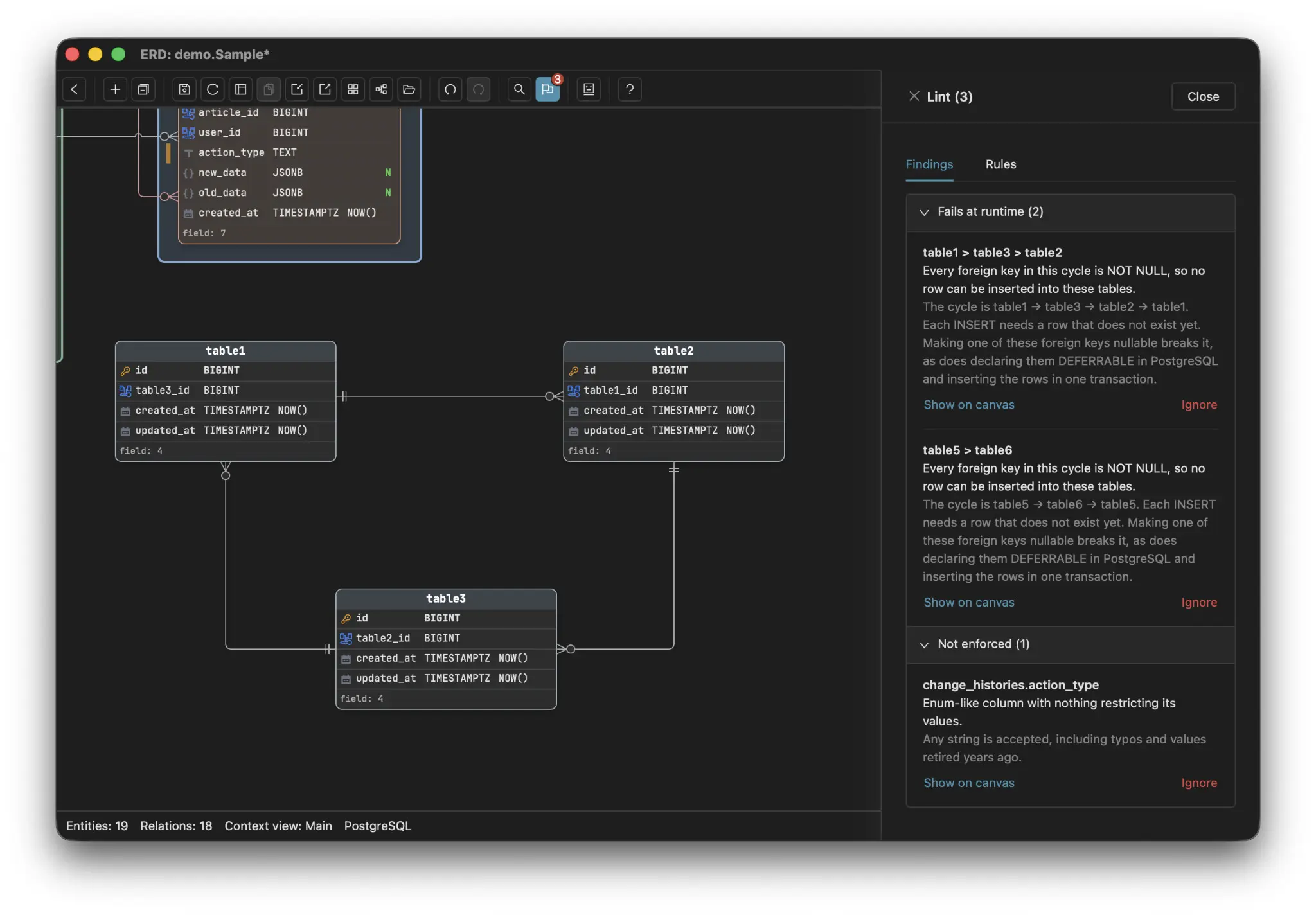
Both invisible shapes are sitting in that one panel. table5 > table6 is the mutual pair and table1 > table3 > table2 is the ring, and the rule reports them identically because to a traversal they are one defect at two lengths. Look at the canvas underneath and the ring is three unremarkable relationships, each drawn between a different pair of tables, none of which says cycle by itself. The finding names the hops in order - table1 → table3 → table2 → table1 - says what it costs, that each INSERT needs a row that does not exist yet, and states both fixes in the same breath: make one of these foreign keys nullable, or declare them DEFERRABLE on PostgreSQL and insert the rows in one transaction.
Two properties of how that finding is reported matter more than the check itself.
It runs against the model, not the server. Every input the rule needs - which relationships exist, which columns are nullable - is already written down in the diagram, so the check needs the schema rather than a connection, in exactly the way a rule reading which date columns are missing their time zone needs nothing but the types in front of it. You get the answer while designing, on a plane, before the migration exists, rather than at seed time on an environment that does not exist yet.
And it lands on the diagram. Every finding carries a Show on canvas link, and taking it draws a colored strip in the margin beside each entity in the cycle, at the exact field row concerned, rather than leaving you with a list to translate back into the picture - the orange strip visible on the entity at the top of that canvas is the same mechanism reporting the unrelated change_histories.action_type finding. Nullability is already legible there: a nullable field carries a green N badge on the entity, so once you break the cycle, the thing that broke it is visible on the canvas at a glance instead of being a fact you have to remember. Clicking the relationship highlights both ends, the foreign key field on one entity and the primary key it points at on the other, which is how you trace a ring back through its hops.
If the cycle is deliberate and you have solved it with deferral, ignore that single finding. The ignore is saved in the diagram’s JSON file and travels with it, so the decision is recorded once for the team rather than re-dismissed by each person who opens the file.
One honest limit: Schemity has no DEFERRABLE toggle on a relationship. It models cardinality, ON DELETE and ON UPDATE, and its answer to a cycle is the modelling decision rather than a constraint flag - so a deferrable constraint is something you add in the migration and record in the ignore, not something the ERD holds for you.
Which side should be nullable?
Assuming you are not deferring, one column in the cycle has to accept NULL, and the choice is not arbitrary.
Pick the side where absence is a real state of the world, not the side that is easier to change. A department genuinely can exist before its manager is appointed, so departments.manager_id being nullable describes reality. An employee who belongs to no department is usually a data error, so making employees.department_id nullable to fix an insert ordering problem quietly legalises a row nobody wants. Both choices unblock the insert. Only one of them is still true a year later.
The reason this matters beyond taste is that NULL then means something, and every query has to handle it. A nullable foreign key is also a nullable column in every unique constraint it participates in, where NULLs compare as distinct and the constraint stops enforcing what it appears to enforce. Choosing the wrong side to relax buys one insert and pays for it in every read.
The third option is to remove the cycle rather than survive it. If both directions are genuinely required and neither absence is real, the reference that does not belong to the entity moves into its own table: a department_managers table holding (department_id, employee_id) with a unique constraint on department_id says one manager per department, in the same shape a junction table uses for the many-to-many case, and both original tables now point one way only. The cost is a join. The benefit is a schema with no cycle in it at all, which is also a schema whose rows can be inserted in any order, on any engine, forever.
What a cycle does to deletes
The insert is the loud failure. The delete is the quiet one.
Referential actions are evaluated in the same graph, so a cycle carrying ON DELETE CASCADE describes a delete that travels back to where it started. Engines guard against the infinite case, but the guard varies - SQL Server refuses to create cyclic cascade paths outright, MySQL and PostgreSQL accept them and resolve the traversal at runtime - and the practical result is that the blast radius of one DELETE in a cycle is genuinely hard to reason about from the SQL. Schemity draws a bold crow’s foot at the child end of any relationship whose foreign key cascades, so the rows a parent delete takes with it are visible on the canvas without opening a dialog, and a cascade inside a cycle reads as a bold ring rather than as three unrelated decisions.
At the architecture scale the same question repeats between groups of tables rather than between tables. A context view is a focused subset of the main diagram - one domain’s entities, arranged for reading, with the main view still holding the schema. On the Context Map, each context view becomes a node and arrows carry the count of foreign keys flowing in each direction, with a curved arrow rather than a straight one where two contexts depend on each other - so a mutual dependency between two bounded contexts is a shape you scan for rather than a thing you audit. Indirect cycles across three or more contexts are the same invisible case one level up, which is why the AI chat reads the map to answer that question directly instead of asking you to trace arrows.
The one-line version
A foreign key cycle where every column is NOT NULL is a schema that compiles and cannot run. Deferral helps on PostgreSQL, Oracle and SQLite and does not exist on MySQL or SQL Server, and even where it exists it hands the ordering problem to your insert code rather than removing it. The durable fixes are both modelling decisions: make the side where absence is real nullable, or move the reference into its own table.
What you should not rely on is seeing it. Two of the three shapes are invisible on a canvas, which is the general property of a schema defect that involves more than one object at a time - the same reason a link table with nothing enforcing uniqueness over its pair looks exactly like one that is correct, and why the ERD is the right place to check the model rather than the migration that only ever shows you the delta. Draw the relationships, then let something walk them.
Frequently asked questions
What is a circular foreign key?
A circular foreign key is a set of foreign keys that leads back to where it started: a table referencing itself, two tables referencing each other, or a longer ring of three or more. The cycle is legal on every major engine and only becomes a problem when every column in it is NOT NULL, because then each row in the cycle requires a row that has not been written yet.
How do I insert the first row into two tables that reference each other?
Three ways, in order of how little they cost you. Make one of the two foreign key columns nullable, insert the first row with NULL, then update it. Or declare the constraint DEFERRABLE INITIALLY DEFERRED on PostgreSQL, Oracle or SQLite and do both inserts inside one transaction, which requires generating the key values yourself since NOT NULL is never deferred. Or move the reference out of the pair into a third table, which removes the cycle from the schema instead of working around it.
Does MySQL support deferred foreign key checks?
No. The MySQL manual states that MySQL does not support deferred constraint checking, which is also why it treats NO ACTION as RESTRICT. SQL Server has no deferrable constraints either. On both engines a cycle of NOT NULL foreign keys has no transactional escape hatch, so one of the columns has to be nullable or the cycle has to go.