DROP TABLE ... CASCADE in PostgreSQL does not delete the rows in tables that reference it: it drops the database objects that depend on the table, and leaves those rows where they are. The danger is that the list of objects is longer than the foreign keys people expect, it can include another table and another table’s column, and PostgreSQL reports it only as a NOTICE after the fact.
Everything below ran on PostgreSQL 18.3 in a throwaway container. The table being dropped is customers (1,000 rows of its own), with one of each kind of thing that can depend on a table:
CREATE TABLE customers (
    id bigint GENERATED ALWAYS AS IDENTITY PRIMARY KEY,
    email text NOT NULL UNIQUE,
    tier text NOT NULL DEFAULT 'free'
);
CREATE TABLE orders (
    id bigint GENERATED ALWAYS AS IDENTITY PRIMARY KEY,
    customer_id bigint NOT NULL REFERENCES customers (id) ON DELETE CASCADE,
    total numeric(12,2) NOT NULL
);
CREATE TABLE order_items (
    id bigint GENERATED ALWAYS AS IDENTITY PRIMARY KEY,
    order_id bigint NOT NULL REFERENCES orders (id) ON DELETE CASCADE,
    sku text NOT NULL
);
CREATE VIEW customer_totals AS
    SELECT c.id, c.email, sum(o.total) AS total
    FROM customers c JOIN orders o ON o.customer_id = c.id GROUP BY c.id, c.email;
CREATE VIEW big_spenders AS SELECT * FROM customer_totals WHERE total > 1000;
CREATE MATERIALIZED VIEW customer_tiers AS SELECT tier, count(*) FROM customers GROUP BY tier;
CREATE FUNCTION customer_email(p_id bigint) RETURNS text LANGUAGE sql
    AS 'SELECT email FROM customers WHERE id = p_id';
CREATE FUNCTION customer_email_atomic(p_id bigint) RETURNS text LANGUAGE sql
    BEGIN ATOMIC SELECT email FROM customers WHERE id = p_id; END;
CREATE FUNCTION touch() RETURNS trigger LANGUAGE plpgsql AS $$ BEGIN RETURN NEW; END $$;
CREATE TRIGGER customers_touch BEFORE UPDATE ON customers FOR EACH ROW EXECUTE FUNCTION touch();
CREATE TABLE vip_customers (discount int NOT NULL DEFAULT 10) INHERITS (customers);
CREATE TABLE customer_snapshots (taken_at timestamptz NOT NULL DEFAULT now(), snapshot customers);
CREATE SEQUENCE customer_ref_seq OWNED BY customers.email;
CREATE TABLE tickets (id bigint PRIMARY KEY DEFAULT nextval('customer_ref_seq'), subject text NOT NULL);
ALTER TABLE orders ENABLE ROW LEVEL SECURITY;
CREATE POLICY orders_paying ON orders USING (EXISTS (
    SELECT 1 FROM customers c WHERE c.id = customer_id AND c.tier <> 'free'));
orders and order_items hold 10,000 rows each, vip_customers holds one row and customer_snapshots five. Half the customers are on a paid tier, so the policy shows 5,000 orders to a role app that has SELECT on orders and customers.
Postgres DROP TABLE CASCADE: what does it drop?
It drops every object that depends on the table, and every object that depends on those, and here that was nine objects besides the table.
BEGIN;
DROP TABLE customers CASCADE;
NOTICE:  drop cascades to 9 other objects
DETAIL:  drop cascades to column snapshot of table customer_snapshots
drop cascades to constraint orders_customer_id_fkey on table orders
drop cascades to view customer_totals
drop cascades to view big_spenders
drop cascades to materialized view customer_tiers
drop cascades to function customer_email_atomic(bigint)
drop cascades to table vip_customers
drop cascades to default value for column id of table tickets
drop cascades to policy orders_paying on table orders
The NOTICE is a flat list, but the dependencies are not. Drawn as a tree, three of the nine are reached through something other than the table itself:
customers
├── constraint orders_customer_id_fkey   (on orders)
├── view customer_totals
│   └── view big_spenders                (reads only customer_totals)
├── materialized view customer_tiers
├── function customer_email_atomic(bigint)
├── table vip_customers                  (INHERITS)
├── type customers                       (the table's row type)
│   └── column customer_snapshots.snapshot
├── sequence customer_ref_seq            (OWNED BY customers.email)
│   └── default of tickets.id
└── policy orders_paying (on orders, reads customers)| Dependent | What CASCADE did | What you lose |
|---|---|---|
Foreign key orders_customer_id_fkey | Dropped the constraint | The check; orders kept all 10,000 rows |
View customer_totals | Dropped | The view |
View big_spenders, which reads only the other view | Dropped | The view |
Materialized view customer_tiers | Dropped | The view and its stored result |
Function with a BEGIN ATOMIC body | Dropped | The function |
| Function with a string body | Kept | Nothing yet: it fails on its next call |
Table vip_customers, which inherits from customers | Dropped | The table and its rows |
Column customer_snapshots.snapshot, typed customers | Dropped | The column and the 5 values in it |
Default of tickets.id, on a sequence customers owns | Dropped | The default; the next insert fails |
Policy orders_paying on orders | Dropped | The policy; orders reads as empty to every role but its owner |
Trigger customers_touch on customers | Went with the table | Nothing extra; its function touch() stays |
Without CASCADE, the same statement is refused and names the same nine objects in the error’s DETAIL. That refusal is the default, and writing RESTRICT says it out loud.
Does DROP TABLE CASCADE delete rows in other tables?
No: it removes the foreign key constraint and leaves the referencing rows in place.
After the drop, orders and order_items still held 10,000 rows each, and orders.customer_id was a plain column full of ids that pointed at nothing. The ON DELETE CASCADE on that key did not run, because no row was deleted: the table was removed.
Three statements you might run against customers carry the word cascade, and they do three different jobs:
| Statement | What cascades | Result on orders here |
|---|---|---|
DROP TABLE customers CASCADE | Dependent objects | Foreign key dropped, 10,000 rows kept |
TRUNCATE customers CASCADE | The truncate, to referencing tables | Emptied, and order_items with it |
DELETE FROM customers with ON DELETE CASCADE | The delete, row by row | Matching rows deleted, here all of them |
A plain TRUNCATE customers is refused while a foreign key references the table, with the hint Truncate table "orders" at the same time, or use TRUNCATE ... CASCADE.
Three of the nine objects do take stored data with them, and none is a foreign key: the inheriting table vip_customers with its rows, the snapshot column with its values, and the materialized view with its stored result, the only one of the three you can rebuild.
What is left broken after the drop?
Three things kept existing and stopped working: a function, an insert, and a whole table’s visibility.
The string-bodied function is not in the NOTICE, because PostgreSQL does not track what a string body reads. It fails when called:
SELECT customer_email(1);
-- ERROR:  relation "customers" does not exist
tickets.id lost its default, so the insert that never named the column now fails:
INSERT INTO tickets (subject) VALUES ('after');
-- ERROR:  null value in column "id" of relation "tickets" violates not-null constraint
The sequence itself, customer_ref_seq, is dropped as well and is not in the NOTICE: only the default that used it is named. Putting the default back means a new sequence started above the highest id.
The policy is the quiet one. orders still has row-level security enabled, and with its only policy gone the default is to show nothing. A role that could read 5,000 orders before the drop read 0 after it, with no error.
How do you see the list before you run it?
Run the drop without CASCADE, or run it inside a transaction and roll back.
DROP TABLE customers;
-- ERROR:  cannot drop table customers because other objects depend on it
-- DETAIL:  column snapshot of table customer_snapshots depends on type customers
-- constraint orders_customer_id_fkey on table orders depends on table customers
-- ...
The refusal lists what CASCADE would take, with the reason for each, including objects reached through another object (view big_spenders depends on view customer_totals). Because DDL is transactional in PostgreSQL, the other way is BEGIN; DROP TABLE customers CASCADE;, read the NOTICE, then ROLLBACK. All 1,000 customers were back after the rollback. Note that the drop holds an ACCESS EXCLUSIVE lock on the table and on every table it touches (here orders, tickets, customer_snapshots and vip_customers) until the transaction ends, so reads of orders wait too. Do not leave it open on a live database.
The client sees at most 100 dependents. Past that the message ends and N other objects (see server log for list), and the full list is in the server log.
Neither list includes the string-bodied function. Find those by searching function bodies for the table name, and treat a match as a maybe.
The cautious version of the migration drops each dependent by name, in order, and ends with a DROP TABLE that has no CASCADE. If something new has come to depend on the table since you wrote it, the last statement fails and tells you.
On a production database, many teams split the drop over two releases: rename the table first (ALTER TABLE customers RENAME TO customers_retired), and drop it a release later. Views, policies and foreign keys follow a rename, because PostgreSQL holds them by object id, not by name. Anything that names the table as text, the string-bodied function and the application’s own queries, fails right away, and one more RENAME undoes it. A DROP cannot be undone that way.
Is DROP TABLE CASCADE the same on MySQL, SQL Server and SQLite?
No, and none of them drops dependent objects the way PostgreSQL does.
DROP TABLE t CASCADE | A foreign key into t | A view on t | |
|---|---|---|---|
| PostgreSQL 18.3 | Drops dependents | Constraint dropped | Dropped |
| MySQL 8.4.11 | Keyword accepted and ignored | Drop refused, error 3730 | Left broken, error 1356 on SELECT |
| SQL Server 2022 | Syntax error, Msg 156 | Drop refused, Msg 3726 | Left broken, Msg 208, or refuses the drop if schema-bound (Msg 3729) |
| SQLite 3.54.0 | Syntax error | See below | Left broken, “no such table” |
SQLite is the one that touches rows. With PRAGMA foreign_keys = ON, a plain DROP TABLE customers deletes the table’s rows first, so the foreign key actions run: a child table with ON DELETE CASCADE was emptied, and one with the default NO ACTION and matching rows stopped the drop with “FOREIGN KEY constraint failed”. That is the opposite of PostgreSQL, where the same key on the same tables kept every child row.
How does Schemity show what a table drop takes with it?
Schemity lists each dependent of the table before the migration runs, with what PostgreSQL will do to it.
Schemity is database design software that reads your live database, shows the impact of every schema change before it runs, and keeps the diagram as a file in Git. When you delete a table on a connected PostgreSQL diagram, the planned migration drops the foreign keys the diagram knows by name and then writes DROP TABLE IF EXISTS "customers" CASCADE. So what the CASCADE reaches is exactly the part worth reading, and impact analysis (Schemity Pro) puts it under Dependent objects: the views, including a view that reads the table only through another view, the materialized view, the policy, the BEGIN ATOMIC function, the inheriting table, the typed column and the other table’s default, each with “CASCADE drops it too, and the database reports that only as a notice.” The string-bodied function is listed as one that mentions the table and may fail the next time it runs. This is the list you would otherwise get from the NOTICE, read before the statement instead of after, which is the point of being able to see the impact of every change.
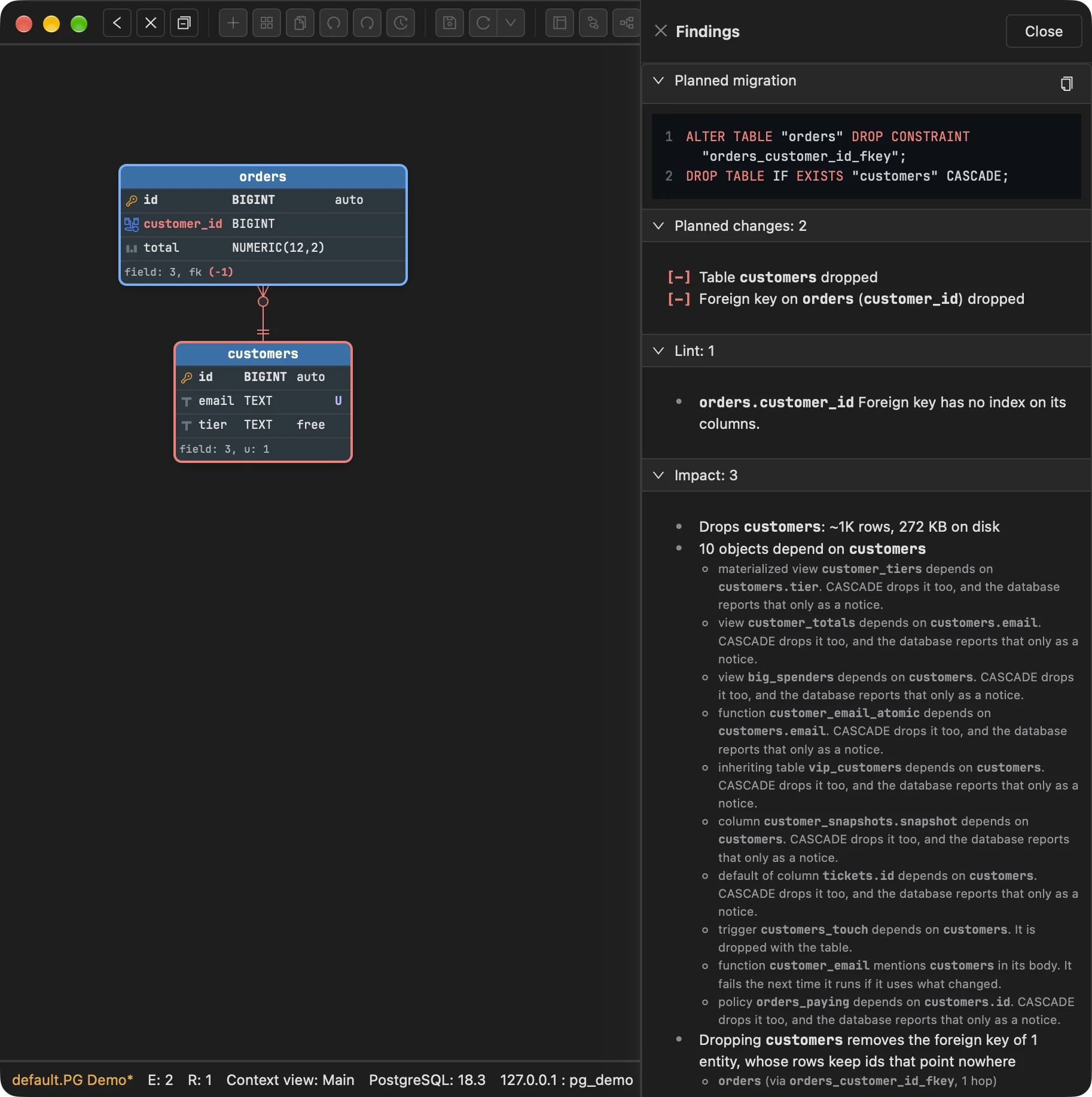
Most of these objects never appear on an ERD. A diagram draws tables, columns and foreign keys, so the views, policies, functions and sequence defaults that CASCADE reaches are exactly the part a diagram leaves out, the same way it leaves out what ON DELETE CASCADE will delete. A foreign key from a table in another schema is on the same list too, since it is outside the diagram and CASCADE drops it as well. In a modular monolith that is often another module’s foreign key, which the team dropping the table may never have seen.
The list has limits, and they matter more than the list. It covers what the database records. The string-bodied function is found by matching the table’s name as a whole word in the function’s source, so a function that builds the name at run time, such as EXECUTE format('SELECT ... FROM %I', 'cust' || 'omers'), is not found. Nothing outside the database is found at all: the application’s queries, ORM models, reports, scheduled jobs and other services that read the table. Impact analysis reads the database, not your application, so an empty list means the database holds nothing else that depends on the table, not that nothing reads it. Searching the codebase, and the rename-first release above, cover the rest.
The same question for one column, where PostgreSQL drops some dependents without any CASCADE at all, is in what DROP COLUMN takes with it.
Frequently asked questions
Does DROP TABLE CASCADE delete rows in other tables in PostgreSQL?
No. It drops the foreign key constraint that pointed at the table and leaves the referencing rows in place, now pointing at nothing. In the test here, orders kept all 10,000 rows after DROP TABLE customers CASCADE. The statement that empties referencing tables is TRUNCATE ... CASCADE, and the one that deletes matching rows is a DELETE with ON DELETE CASCADE.
How do I see what DROP TABLE CASCADE will drop before running it?
Run DROP TABLE without CASCADE. PostgreSQL refuses and prints the dependent objects in the error's DETAIL, including the ones reached through another object (the first 100; the rest go to the server log). Or run the CASCADE form inside BEGIN, read the NOTICE, and ROLLBACK, since DDL is transactional in PostgreSQL.
Does MySQL support DROP TABLE CASCADE?
It accepts the keyword and ignores it. On MySQL 8.4.11 DROP TABLE customers CASCADE still failed with error 3730 while a foreign key referenced the table, and once the key was gone it dropped the table and left the view that read it broken (error 1356 on the next SELECT).