A schema diff that compares your migration’s text with what the database prints will report CHECK constraints and defaults as changed even when nothing changed, because PostgreSQL and MySQL store a parsed rule and print it back in their own words. Most of those differences are spelling. A few are real, and they are the ones a text diff makes easiest to miss.
Here is an ordinary table, written the way a migration writes it:
CREATE TABLE orders (
  id bigint GENERATED ALWAYS AS IDENTITY PRIMARY KEY,
  status varchar(20) NOT NULL DEFAULT 'pending' CHECK (status IN ('pending', 'paid', 'shipped')),
  quantity int NOT NULL CHECK (quantity BETWEEN 1 AND 100),
  channel text NOT NULL DEFAULT 'web' CHECK (channel NOT IN ('test', 'internal')),
  is_gift bool NOT NULL DEFAULT FALSE,
  created_at timestamptz NOT NULL DEFAULT now(),
  imported_at timestamptz NOT NULL DEFAULT 'now'
);
Everything below was run on PostgreSQL 18.3 and MySQL 8.4.11 in throwaway containers. Ask PostgreSQL for this table back, with \d orders, pg_dump --schema-only or pg_get_constraintdef, and not one of the three CHECK constraints reads the way it was written.
Why does postgres change my check constraint?
Because PostgreSQL keeps the parsed expression, not your text, and rebuilds the text every time you ask for it.
A CHECK is stored as an expression tree in pg_constraint. When \d, pg_dump or an ORM’s introspection asks for it, pg_get_constraintdef turns the tree back into SQL, and the PostgreSQL manual says what that text is: “a decompiled reconstruction, not the original text of the command.” The reconstruction expands shorthand, adds the casts the parser inserted, and brackets every sub-expression:
| Written in the migration | Printed by pg_get_constraintdef, inside CHECK (...) |
|---|---|
status IN ('pending', 'paid', 'shipped') on varchar(20) | ((status)::text = ANY ((ARRAY['pending'::character varying, 'paid'::character varying, 'shipped'::character varying])::text[])) |
quantity BETWEEN 1 AND 100 | ((quantity >= 1) AND (quantity <= 100)) |
channel NOT IN ('test', 'internal') | (channel <> ALL (ARRAY['test'::text, 'internal'::text])) |
The manual defines each rewrite as equivalent. IN is “a shorthand notation for” expression = value1 OR expression = value2 OR ..., NOT IN is the same with <> and AND (row and array comparisons), and a BETWEEN x AND y “is equivalent to a >= x AND a <= y” (comparison predicates). Columns and defaults get the same treatment: int prints as integer, bool as boolean, timestamptz as timestamp with time zone, and DEFAULT 'pending' as 'pending'::character varying.
So the first question about any reported difference is not “what changed” but “did the rule change, or only its spelling”.
Which schema differences are only spelling?
Every rewrite in the table above is spelling: the database accepts and rejects exactly the same rows as the rule you wrote.
MySQL rewrites less, but it rewrites. Here is a MySQL version of the table, written with int(11) and boolean the way older tutorials and generators still write them, from a utf8mb4 connection:
CREATE TABLE orders (
  id bigint AUTO_INCREMENT PRIMARY KEY,
  status varchar(20) NOT NULL DEFAULT 'pending' CHECK (status IN ('pending', 'paid', 'shipped')),
  quantity int(11) NOT NULL CHECK (quantity BETWEEN 1 AND 100),
  is_gift boolean NOT NULL DEFAULT FALSE,
  created_at timestamp NOT NULL DEFAULT now()
);
MySQL 8.4.11 prints it back with SHOW CREATE TABLE like this:
| Written | MySQL 8.4 prints |
|---|---|
quantity int(11) NOT NULL | `quantity` int NOT NULL |
is_gift boolean NOT NULL DEFAULT FALSE | `is_gift` tinyint(1) NOT NULL DEFAULT '0' |
created_at timestamp NOT NULL DEFAULT now() | `created_at` timestamp NOT NULL DEFAULT CURRENT_TIMESTAMP |
CHECK (status IN ('pending', 'paid', 'shipped')) | CONSTRAINT `orders_chk_1` CHECK ((`status` in (_utf8mb4'pending',_utf8mb4'paid',_utf8mb4'shipped'))) |
The MySQL manual says the integer display width “is deprecated”, which is why int(11) comes back as int, and that BOOL and BOOLEAN “are synonyms for TINYINT(1)”. The unnamed CHECK gets a generated name, orders_chk_1, from the table name, _chk_ and a number.
The _utf8mb4 in front of each value is a character set introducer, and MySQL records the one each literal had when the constraint was created. A literal written without one takes the connection’s character set. We ran the identical CREATE TABLE twice on one MySQL 8.4.11 server, once after SET NAMES utf8mb4 and once after SET NAMES latin1, and information_schema.CHECK_CONSTRAINTS stored two different texts for one rule:
-- created from a utf8mb4 client
(`status` in (_utf8mb4'pending',_utf8mb4'paid'))
-- created from a latin1 client
(`status` in (_latin1'pending',_latin1'paid'))
The stock mysql client in the official Docker image connected as latin1. If production was migrated from one client and staging from another, every CHECK with a string in it differs between them. For plain ASCII values none of those differences is a change to the rule; a non-ASCII value is another matter. We created CHECK (v IN ('café')) once from a latin1 connection and once from a utf8mb4 one, sending the same bytes. Inserting 'café' over a utf8mb4 connection worked on the second table and failed the CHECK on the first: same migration, a different rule. (MySQL also stored that one-value IN as =, one more respelling.)
Which differences are real schema drift?
A difference is real when the database would accept or reject a different row, or fill in a different value, and two of them look like spelling at first glance.
A default that was frozen at creation time. The table above says DEFAULT 'now' on imported_at and DEFAULT now() on created_at. They look like two spellings of one default. They are not:
SELECT column_name, column_default
FROM information_schema.columns
WHERE table_name = 'orders' AND column_name IN ('created_at', 'imported_at');
column_name | column_default
-------------+----------------------------------------------------------
created_at | now()
imported_at | '2026-11-25 02:47:42.91941+00'::timestamp with time zone'now' is a string the timestamp type converts “to a specific time value as soon as they are read”, in the words of the PostgreSQL date/time documentation, so the CREATE TABLE stored the moment it ran. Every row inserted afterwards gets that same timestamp: a row we inserted later got 02:47:43.16312 in created_at and the table’s creation time, 02:47:42.91941, in imported_at. In a dump this is easy to read past as “PostgreSQL printing my default its own way”, which is exactly the habit the spelling rewrites teach.
A value whose case changed. CHECK (status IN ('Paid', 'Shipped')) and CHECK (status IN ('paid', 'shipped')) differ only in case, and on PostgreSQL they are different rules: PostgreSQL 18.3 refused 'paid' under the first, and so did MySQL 8.4.11 on a utf8mb4_bin column. Under MySQL’s default utf8mb4_0900_ai_ci collation both accept the same rows, so the only sign that someone changed the constraint is its text, and a comparison that ignores case will never show it. Text inside quotes is data. A comparison that folds case to ignore IN versus in has to stop folding at the first quote.
MySQL’s boolean is a small integer. Not drift, but a gap the tinyint(1) in the dump is telling you about: INSERT INTO orders (status, quantity, is_gift) VALUES ('paid', 1, 7) succeeded on MySQL 8.4.11 and stored 7. If the column must hold only 0 and 1, add CHECK (is_gift IN (0, 1)).
| Difference you see | Same rule? | What to do |
|---|---|---|
IN vs = ANY (ARRAY[...]), NOT IN vs <> ALL, BETWEEN vs >= AND <= | Yes | Ignore |
Added casts, brackets, int vs integer, int(11) vs int | Yes | Ignore |
_latin1'x' vs _utf8mb4'x' in a MySQL CHECK | Yes, for ASCII values | Pin the client character set in migrations |
DEFAULT 'now' vs DEFAULT now() | No | Replace the frozen default |
'Paid' vs 'paid' inside a CHECK or default | No, except under a case-insensitive collation | Decide which one the application writes |
How do you compare a migration to the live schema without false drift?
Apply the migrations to a scratch database and compare the two databases’ own output, so both sides go through the same reconstruction.
Comparing a schema migration file, a schema.sql or an ORM model with a dump of production compares your spelling with the database’s, and every one of the first two rows of the table above shows up as a change. Comparing two databases does not: run the migrations into an empty throwaway database of the same version, then print the rules from both with the same query and diff the outputs.
SELECT conrelid::regclass::text AS table_name, conname, pg_get_constraintdef(oid) AS definition
FROM pg_constraint
WHERE contype = 'c' AND connamespace = 'public'::regnamespace
ORDER BY 1, 2;
Both sides now print = ANY (ARRAY[...]), so what remains in the diff is a real difference: a constraint one side lacks, a value list that differs, a default frozen on one side. The same works for defaults with SELECT table_name, column_name, column_default FROM information_schema.columns WHERE table_schema = 'public' ORDER BY 1, 2;, and for whole tables with pg_dump --schema-only --restrict-key=schema from both databases (without a fixed key, every dump since the August 2025 minor releases carries a random one, and two dumps of one schema differ). On MySQL, add SET NAMES utf8mb4; to the top of every migration so each environment stores the same introducers, or strip _charset prefixes from both sides before comparing.
Two limits. The scratch database must run the same major version, because the reconstruction can change between releases. And this compares structure only: it says the two databases hold the same rules, not that the rows in production satisfy them, which matters for a constraint added NOT VALID.
How does Schemity read a CHECK constraint PostgreSQL has rewritten?
Schemity reads the rule, not the spelling: a value-list CHECK comes back as its column and its values, and a saved, refreshed or imported diagram compares CHECK constraints by what they enforce and defaults by value.
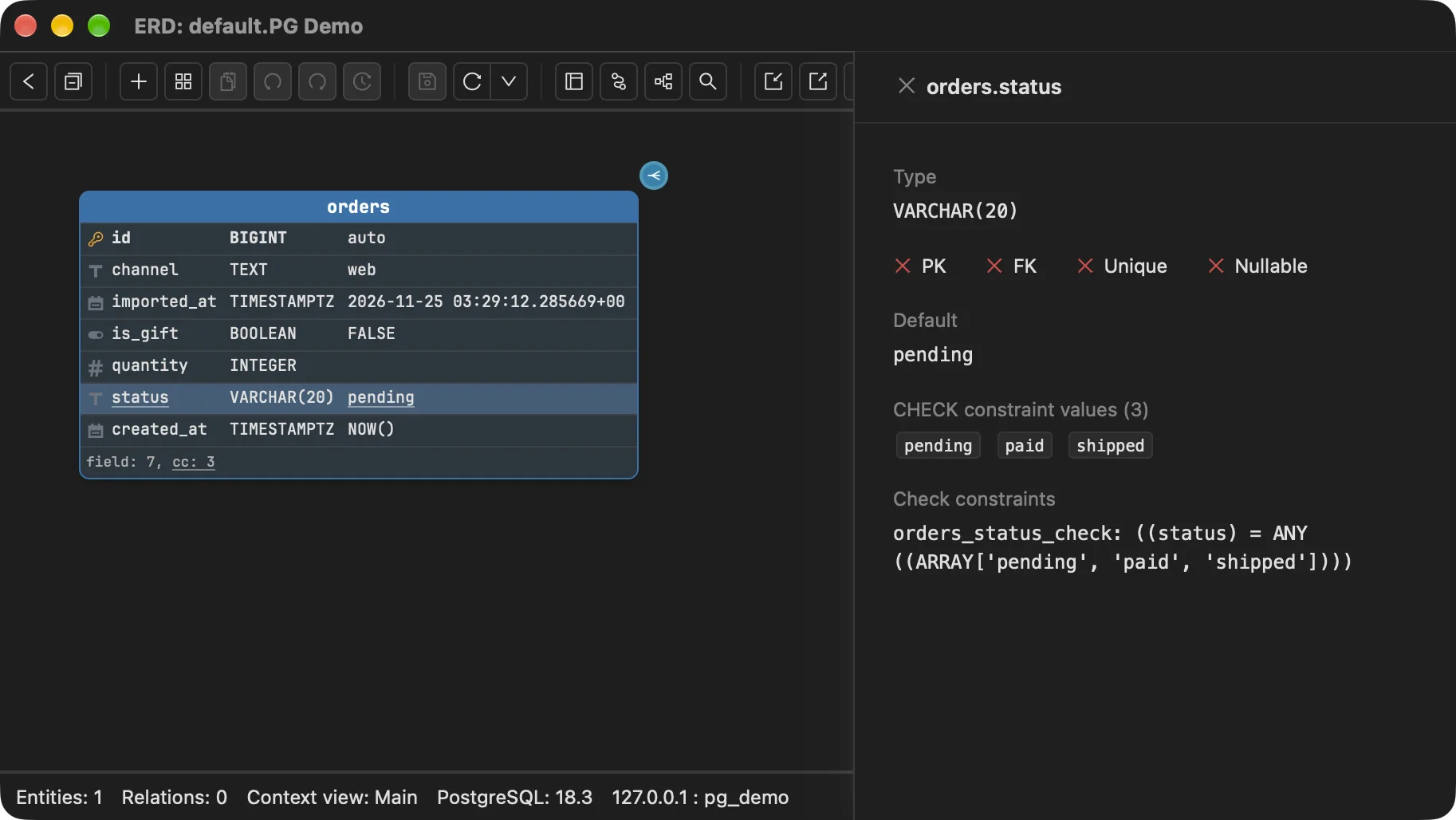
Schemity is database design software that reads your live database, shows the impact of every schema change before it runs, and keeps the diagram as a file in Git. To understand your schema it reads what the database stores and shows it as a rule you can check at a glance. On the orders table above, connected live to PostgreSQL 18.3, the status check reads as the column status with the values pending, paid and shipped, and lint treats the column as restricted (lint is a Schemity Pro feature). The Field details panel puts the two readings side by side: the three values as the rule, and under them orders_status_check as PostgreSQL stores it, ((status) = ANY ((ARRAY['pending', 'paid', 'shipped']))). Types arrive in plain SQL: quantity int reads as INTEGER and is_gift bool as BOOLEAN.
imported_at, on the other hand, shows its real default, the moment that copy of the table was created: 2026-11-25 03:29:12.285669+00. Schemity does not tidy a frozen default back into something that looks like now(), because that is the one rewrite that changed what the column does.
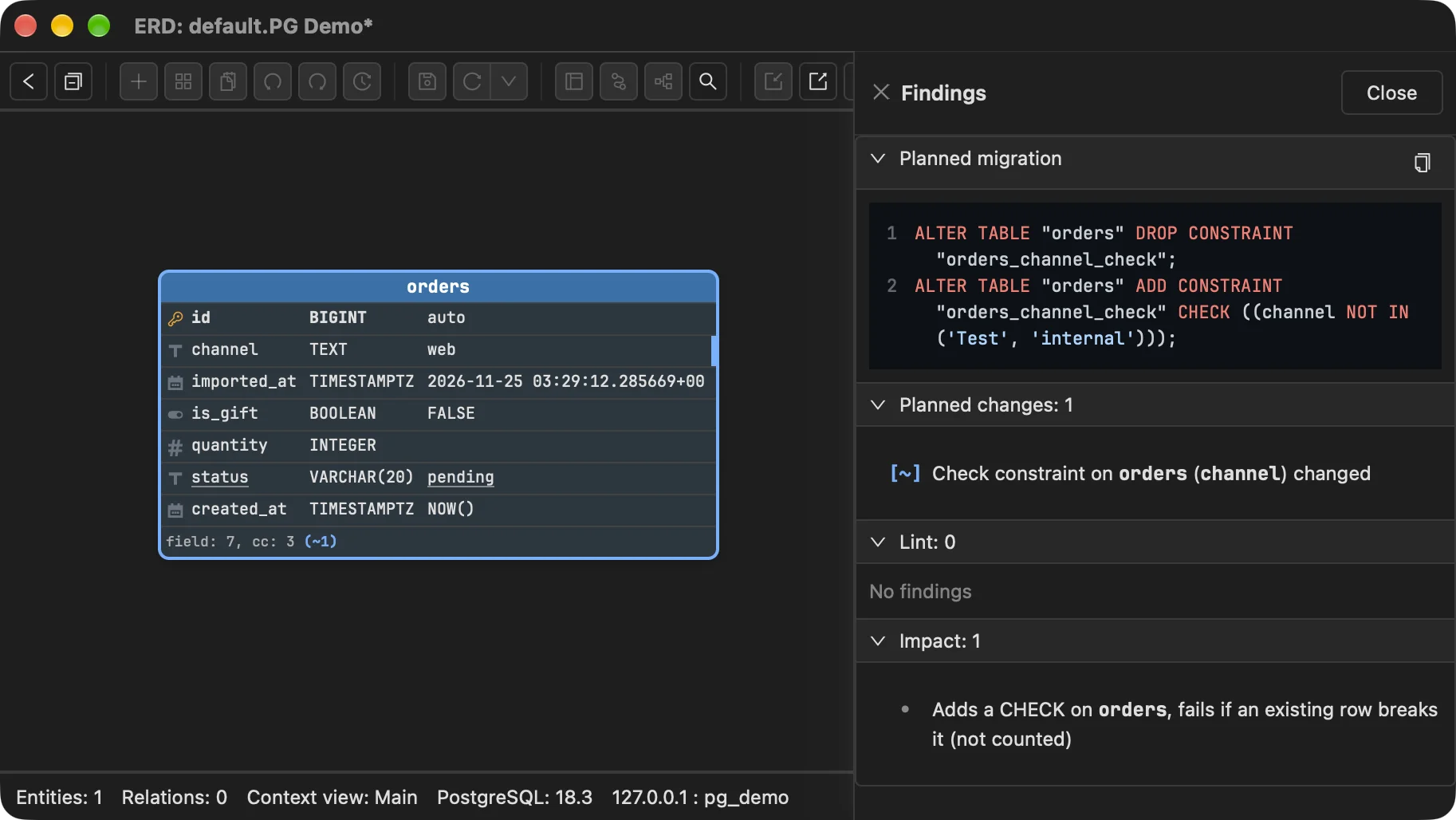
When the diagram and the database spell one rule two ways, Schemity compares them by meaning. That matters in three places: Refresh after the database changed under unsaved edits, Import SQL of a migration script over a diagram read from the live database, and the migration SQL a save would run. We tested the third directly while writing this post. On a diagram of the table above, plus a refunds table created by hand in psql, we restated the database’s rules the way a person types them, channel NOT IN ('test', 'internal') on orders and amount BETWEEN 1 AND 1000 on refunds, and Schemity planned no statements. Changing one value to 'Test' planned ALTER TABLE "orders" DROP CONSTRAINT "orders_channel_check"; and the matching ADD CONSTRAINT, as it should. The Findings drawer, a Schemity Pro feature, shows that one change with its impact; Schemity Free shows the same migration SQL before it is applied.
Running this scenario also found two cases Schemity got wrong, both fixed in the next release. A drafted BETWEEN, IN or NOT IN CHECK that a framework’s migration then created counted as changed against the database’s >= AND <=, = ANY or <> ALL form, so the next save would have dropped and re-added a constraint nobody changed. And on PostgreSQL, MySQL and Snowflake a CHECK value edited only in case, 'Paid' to 'paid', planned no migration at all, because the comparison folded case inside quoted values too. Both now follow the drift table above: spelling is ignored, quoted values are kept exactly.
Related reading
If the differences you are chasing are between environments rather than between a migration and a database, comparing staging and production database schemas covers that comparison, and tracking schema changes made outside migrations covers how they get there. For choosing the rule in the first place, see enum vs CHECK constraint vs lookup table. The PostgreSQL round trip on Mastodon and Saleor measures how much of a real schema survives being read and written back.
Frequently asked questions
Why does PostgreSQL change my CHECK constraint?
PostgreSQL stores a CHECK as a parsed expression tree and prints it back with pg_get_constraintdef, which the manual calls a decompiled reconstruction, not the original text. On PostgreSQL 18.3, status IN ('pending', 'paid') on a varchar column came back as (status)::text = ANY ((ARRAY['pending'::character varying, 'paid'::character varying])::text[]). The rule is the same; only the spelling changed.
Is = ANY (ARRAY[...]) the same as IN in a PostgreSQL CHECK constraint?
Yes, for a list of values. PostgreSQL turns x IN ('a', 'b') into x = ANY (ARRAY['a', 'b']) when it stores the constraint, x NOT IN (...) into x <> ALL (ARRAY[...]), and x BETWEEN 1 AND 100 into x >= 1 AND x <= 100. A schema diff that compares text will report each of these as a change although no row is checked differently.
Why does MySQL put _utf8mb4 or _latin1 in my CHECK constraint?
MySQL records the character set introducer of every string literal in the stored expression, and a literal written without one takes the connection's character set. On MySQL 8.4.11 the same CREATE TABLE stored _utf8mb4'paid' from a utf8mb4 client and _latin1'paid' from a latin1 client, so two environments built from one migration print different CHECK text. Run SET NAMES utf8mb4 at the top of the migration so every environment stores the same spelling.