Only pgvector gave us an approximate nearest-neighbour index on embeddings that served the search and still accepted writes; MySQL 9.7 Community stores vectors but cannot index them or compute a distance between them, and SQL Server 2025 computes exact distances but made an indexed table read-only on the build we tested. So the choice is less about the column type, which all three have, and more about where the similarity search will run.
We took one pgvector design and moved it with Schemity’s SQL conversion to MySQL 9.7.4 (Community) and SQL Server 2025 (17.0.5035.5, RTM-CU10), then ran each script on the real server. The design is a test table built to exercise every pgvector column type and both of its index methods, so a real table would keep one of the two indexes, not both. On PostgreSQL 17.11 with pgvector 0.8.7:
CREATE EXTENSION IF NOT EXISTS vector;
CREATE TABLE documents (
  id BIGINT GENERATED ALWAYS AS IDENTITY PRIMARY KEY,
  title TEXT NOT NULL,
  embedding VECTOR(1536) NOT NULL,
  summary_embedding HALFVEC(768),
  keywords SPARSEVEC(30000)
);
CREATE INDEX documents_embedding_hnsw ON documents
  USING hnsw (embedding vector_cosine_ops) WITH (m = 16, ef_construction = 64);
CREATE INDEX documents_embedding_ivfflat ON documents
  USING ivfflat (embedding vector_l2_ops) WITH (lists = 100);
pgvector vs MySQL VECTOR vs SQL Server VECTOR: which should store your embeddings?
Use pgvector when the database has to find the nearest embeddings itself, SQL Server 2025 when an exact search that reads every row is fast enough, and MySQL Community only to store vectors that another system searches.
| PostgreSQL 17 + pgvector 0.8.7 | MySQL 9.7.4 Community | SQL Server 2025 (17.0.5035.5) | |
|---|---|---|---|
| Column type | vector, halfvec, sparsevec | VECTOR(n), single precision only | VECTOR(n); VECTOR(n, float16) only with PREVIEW_FEATURES |
| Most dimensions | 16,000; indexed, 2,000 (4,000 for halfvec) | 16,383 | 1,998 (3,996 for float16) |
| Distance in SQL | <=>, <->, <#> operators | None: DISTANCE() is not in Community | VECTOR_DISTANCE, exact |
| Approximate index | HNSW and IVFFlat | Refused, error 6134 | CREATE VECTOR INDEX, preview only |
| Writes with the index in place | Yes | No index to write to | Refused, Msg 42231 |
pgvector ran the source design unchanged. On a table of 5,000 embeddings with the HNSW index, EXPLAIN showed the nearest-neighbour query ORDER BY embedding <=> ... LIMIT 5 as an Index Scan using documents_embedding_hnsw, and an UPDATE and an INSERT both succeeded with the index in place. The one warning came from IVFFlat: built on the still-empty table, it printed “ivfflat index created with little data” and “This will cause low recall”, because IVFFlat chooses its list centres from the rows that exist when the index is built.
What MySQL 9.7 does with a VECTOR column
MySQL 9.7 Community stores vectors, but it can neither index them nor compute a distance between two of them.
The converted script ran: embedding became VECTOR(1536), summary_embedding a single-precision VECTOR(768), and keywords a LONGTEXT, since MySQL has no sparse vector. VECTOR_DIM(embedding) returned 1536 on an inserted row. Then the limits showed. CREATE INDEX x ON documents (embedding) failed with ERROR 6134 (HY000): Non-scalar (e.g., vector) column 'embedding' cannot be used as key, and both DISTANCE(embedding, embedding, 'COSINE') and VECTOR_DISTANCE(...) failed with error 1305, function does not exist. MySQL’s vector functions page explains the second: DISTANCE() “is available only for users of MySQL HeatWave on OCI and MySQL AI; it is not included in MySQL Commercial or Community distributions.”
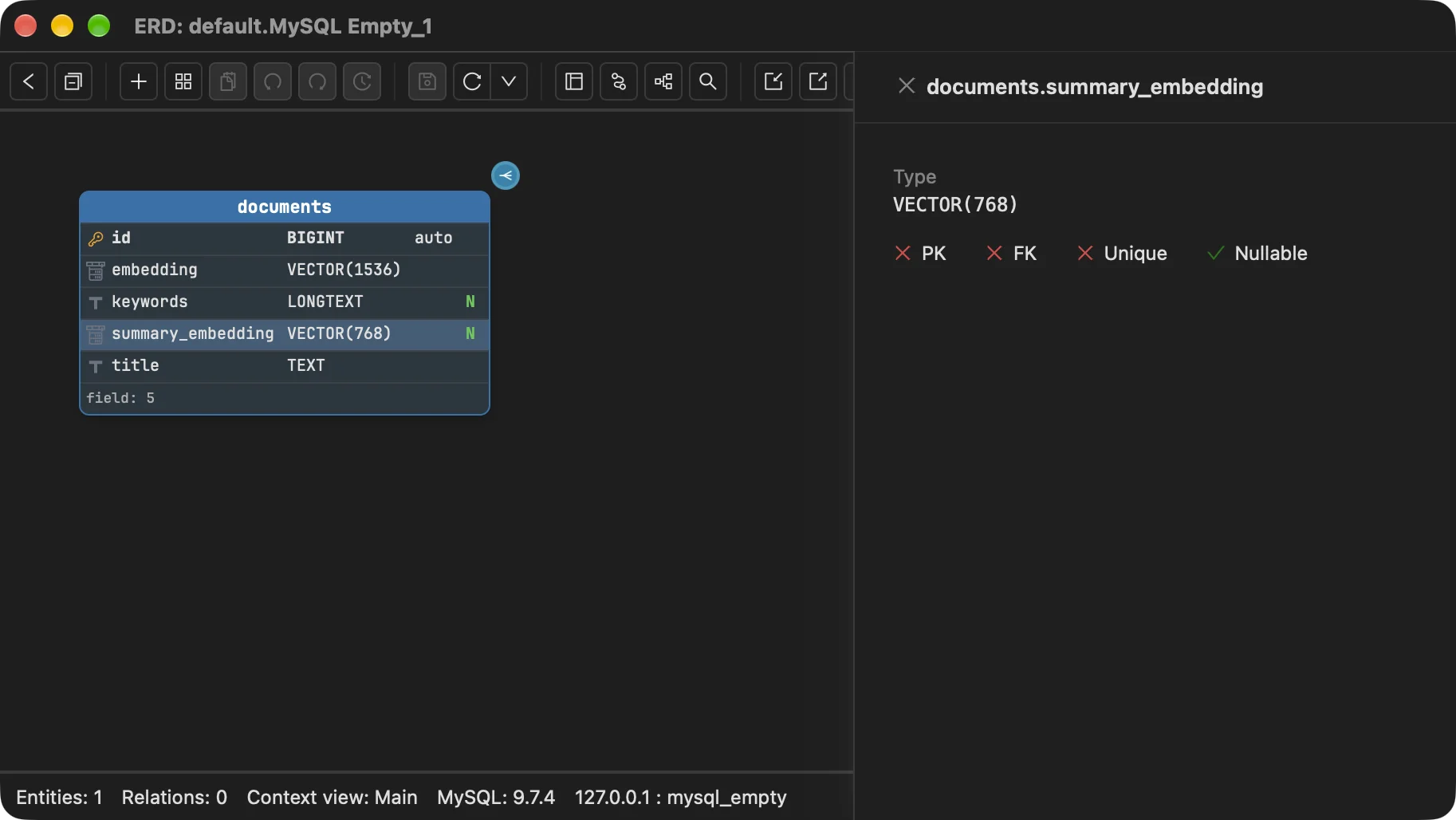
So on MySQL Community the database is a vector store in the literal sense: every similarity query has to read candidate vectors out and rank them in the application. If the rest of the application lives in MySQL, the options are MySQL HeatWave or MySQL AI, a separate vector index next to MySQL, or a PostgreSQL database for the embeddings alone.
What SQL Server 2025 does with a VECTOR column
SQL Server 2025 computes exact distances out of the box, and its approximate index is a preview that, on the build we ran, left the table read-only.
The converted script failed on the first try. summary_embedding VECTOR(768, float16) returned Msg 195: 'float16' is not a recognized vector base type, and the vector data type page says why: in SQL Server 2025, “half-precision (float16) vectors are available in preview”, behind the PREVIEW_FEATURES database scoped configuration. With ALTER DATABASE SCOPED CONFIGURATION SET PREVIEW_FEATURES = ON the same column was accepted, and sys.columns reported it with vector_base_type 1, against 0 for float32. Exact search needed no preview at all: VECTOR_DISTANCE('cosine', v, @q) ranked rows correctly.
The approximate index is where it stops. Microsoft’s CREATE VECTOR INDEX page requires at least 100 rows with vectors, so we built it on a separate 300-row test table, e, with a VECTOR(3) column v. CREATE VECTOR INDEX e_v_idx ON e(v) WITH (METRIC = 'cosine', TYPE = 'diskann') was an unknown statement until PREVIEW_FEATURES was on, and it needed QUOTED_IDENTIFIER ON. Once built, VECTOR_SEARCH worked, and every INSERT, UPDATE and DELETE failed with Msg 42231: Data modification statement failed because table 'e' has a vector index on it. The same page describes a newer index version that “is no longer read-only”, and an ALLOW_STALE_VECTOR_INDEX setting for the older one, but on 17.0.5035.5 the index carried no version number in sys.vector_indexes and the server did not recognise ALLOW_STALE_VECTOR_INDEX. On that build, a vector index is not usable on a table that takes new embeddings; check your own build before planning on one.
How Schemity converts a vector design between databases
Schemity Pro converts a vector design to MySQL, SQL Server or Snowflake, and from the next release its script header names what the target cannot keep, and why.
Schemity is database design software that reads your live database, shows the impact of every schema change before it runs, and keeps the diagram as a file in Git. It reads and writes vector columns on PostgreSQL, MySQL, SQL Server and Snowflake: pgvector’s vector, halfvec and sparsevec with their dimensions, MySQL 9’s VECTOR(n), SQL Server 2025’s VECTOR(n) and its float16 form from sys.columns, and Snowflake’s VECTOR(FLOAT, n); SQL Server and Snowflake are part of Schemity Pro. With Schemity Pro, the SQL export can convert a diagram to another database, as it did for this post. An excerpt of the SQL Server script’s header, as the next release writes it:
-- Converted by Schemity from PostgreSQL to SQL Server. The diagram itself is unchanged.
-- Type mappings:
--   HALFVEC(768) -> VECTOR FLOAT16(768) (1 column): SQL Server 2025 takes float16 vectors only with PREVIEW_FEATURES on (Azure SQL takes them as they are).
--   SPARSEVEC(30000) -> NVARCHAR(MAX) (1 column): SQL Server has no sparse vector; stored as text.
-- Notes:
--   documents: HNSW index documents_embedding_hnsw is left out: SQL Server's CREATE VECTOR INDEX needs PREVIEW_FEATURES, and on SQL Server 2025 17.0.5035 the table then refuses writes.
--   documents: IVFFLAT index documents_embedding_ivfflat is left out: SQL Server's CREATE VECTOR INDEX needs PREVIEW_FEATURES, and on SQL Server 2025 17.0.5035 the table then refuses writes.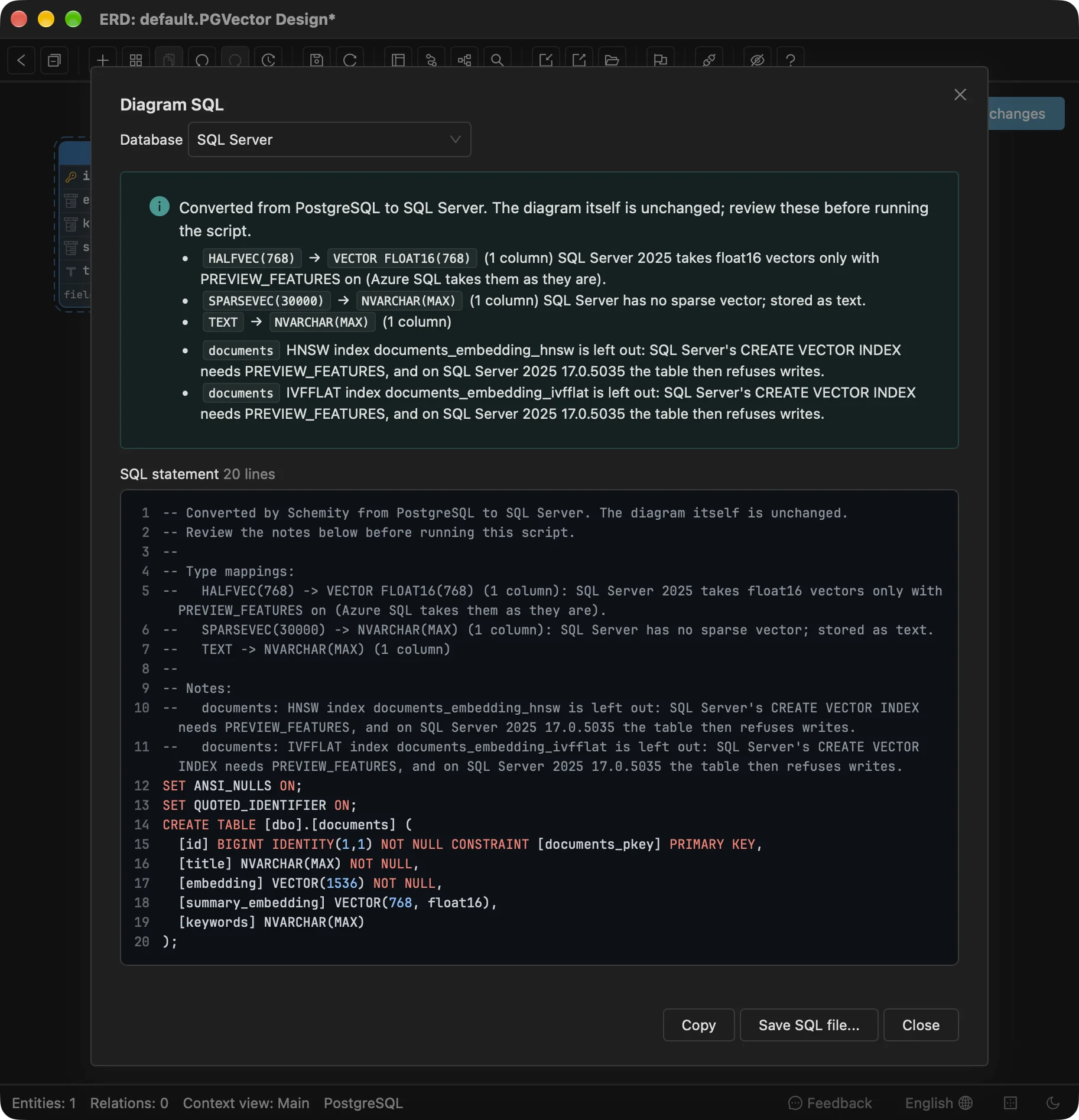
Running the scripts on the real servers is how those lines came to exist. The released conversion writes VECTOR(768, float16) for SQL Server with no warning, a script that fails as it stands, and it lists the HNSW and IVFFlat indexes as left out for being “on an expression or a column prefix, with a WHERE or with NULLS NOT DISTINCT”, a reason that has nothing to do with them. Both are fixed for the next release, where the MySQL header says that MySQL “has no vector index and refuses any index on a VECTOR column”. That is how to design the next one when it has to live on more than one database: decide where the search runs, then let the column type follow.
Which database should hold the embeddings
Put embeddings where their search runs, which today means PostgreSQL with pgvector for anything that needs an index and takes writes.
If the embeddings belong in PostgreSQL, where to put the column is the next decision, and the same conversion notes cover the rest of a schema in MySQL to PostgreSQL schema conversion.
Frequently asked questions
Can MySQL do vector similarity search?
Not in MySQL Community Server. It stores a VECTOR(n) column up to 16,383 dimensions, but MySQL's manual says DISTANCE() is available only in MySQL HeatWave on OCI and MySQL AI, and MySQL 9.7.4 refused an index on a VECTOR column with error 6134. Nearest neighbours have to be found in the application or in another system.
Does SQL Server 2025 have a vector index?
As a preview. CREATE VECTOR INDEX needs PREVIEW_FEATURES turned on, and on SQL Server 2025 17.0.5035.5 every INSERT, UPDATE and DELETE on the indexed table then failed with Msg 42231. Microsoft documents a newer index version that takes writes, but that build did not build it. VECTOR_DISTANCE, which computes an exact distance without an index, worked with no preview setting.
What happens to a pgvector halfvec column in SQL Server?
SQL Server has a half-precision VECTOR(n, float16), but SQL Server 2025 refused it with Msg 195 until PREVIEW_FEATURES was turned on; Azure SQL takes it without that setting. Without it, use a single-precision VECTOR(n), which takes twice the space per dimension.