AI is genuinely good at schema design. Describe a booking system in two sentences and a model will sketch the entities, the foreign keys, the junction tables - a solid first draft in seconds. Every engineer who has tried it knows the pull.
And every engineer doing client work knows the catch. Your schema is the most honest document your business owns. Table names alone reveal the product roadmap: subscriptions, usage_credits, partner_payouts. Pasting your CREATE TABLE statements into a chat website means handing that document to a third party - and if the project is under NDA, or your IT department reviews every tool that touches project data, that is not a gray area. It is a no.
So most designers quietly pick one of two bad options: use AI and hope nobody asks where the schema went, or skip AI and draw everything by hand. There is a third option.
The schema is the secret
We underrate how much a schema leaks. It is not just structure - it is strategy. The presence of a trial_extensions table says something about your conversion funnel. A soft_deleted_reasons column says something about churn. Consultants see this clearly because their contracts spell it out: the client’s data model is confidential material, full stop.
That is why “just use the AI chat in your browser” fails as advice. The problem was never whether AI could help with database design. It was the route the schema had to travel to get that help.
What BYOK actually changes
Schemity is an offline ERD tool - your diagrams are local JSON files, no account, no sync, no vendor server. Its AI chat follows the same philosophy: bring your own key. You plug in your own OpenAI, Claude, Gemini, or DeepSeek API key, and the conversation goes directly from your desktop to the provider you chose. There is no diagram vendor’s cloud in the middle, no second company logging your prompts, no new name to add to the data processing agreement.
That honesty matters, so let’s be precise: when you ask the AI for help, your prompt goes to the model provider - the one you selected, under your own key and your own terms. One relationship, chosen by you, governed by an agreement your IT team has probably already reviewed. And if even that one relationship is off the table - a blanket AI ban, an air-gapped network - Schemity can now run the entire AI loop locally with Ollama, no provider at all. When you are not using the chat, nothing leaves the machine. That is the difference between private AI database design and a cloud ERD product with an AI button on it.
BYOK is not a feature checkbox. It is a statement about who is in the loop: you, and the model provider you picked. Nobody else.
A chatbot that can touch the diagram
Paste-in, paste-out AI is exhausting: copy schema to browser, get SQL back, re-import, fix the layout, repeat. Schemity’s chatbot skips the round trip because it can fully interact with the diagram. Give it an idea - “an inventory system with lots, batches, and expiry tracking” - and it generates the entities and relationships on the canvas. Point it at what exists - “split the address fields out of customers into their own table” - and it modifies the diagram in place.
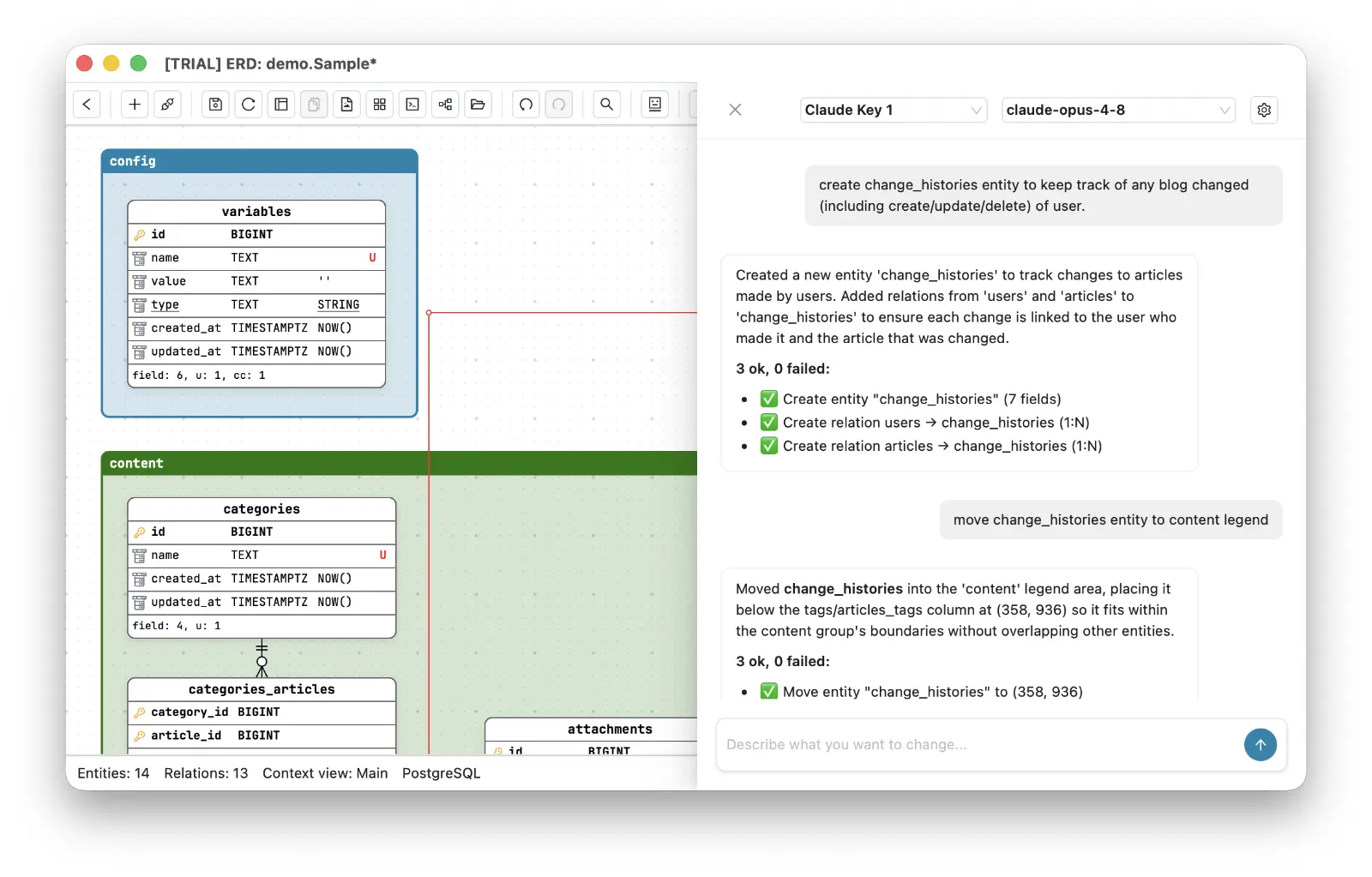
The canvas stays the single source of truth. The AI is a hand on the same whiteboard, not an oracle you transcribe.
You stay the designer
An AI that edits your diagram raises a fair worry: what if it is wrong? Often it will be - first drafts are drafts. That is why the workflow keeps you in charge. Every change lands on the canvas where you can see it, question it, and rearrange it, and full undo/redo means an over-eager suggestion is one keystroke from gone. The model proposes; you dispose.
That division of labor is the point. Let the AI handle the boilerplate guesswork - the obvious foreign keys, the timestamps, the junction table for the N:N you described - and spend your attention on the decisions that actually need a human: boundaries, constraints, and the business rules hiding between the tables.
AI help for your database design does not have to cost you your schema’s privacy. With a BYOK ERD tool on your desktop, it costs an API key.