If you have ever designed a database schema, you have probably drawn an ERD with crow’s foot notation. You learned that a circle means optional, a line means mandatory, and a crow’s foot means many. You felt confident.
Then you opened your SQL editor and had to guess whether the FK should be NULL or NOT NULL. You were not sure if you needed UNIQUE. And nobody told you that one of the notation symbols cannot be enforced in SQL at all.
This article fixes that. We will cover what each symbol actually means, how to translate notation directly into SQL constraints, and where the notation is richer than what your database can enforce.
Throughout this article, we use one consistent convention: parent entity is always on the left, child entity is always on the right. This makes every notation example unambiguous.
If you would rather draw these combinations than read them, Schemity Lite is a free online database schema designer that runs in the browser - no install, no account. Drag a relationship between two entities and it renders in the same crow’s foot notation this article maps to SQL, so you can check a reading against a real diagram as you go.
A Brief History
The crow’s foot symbol was introduced by Gordon Everest in his 1976 paper “Basic Data Structure Models Explained with a Common Example.” Everest used an “inverted arrow” to represent the one-to-many relationship in hierarchical and network data structures, noting that it “inherently and visually depicts the one-to-many relationship” without implying a direction of access.
At that stage, the notation only expressed maximum degree: whether a link could have one or many instances. The minimum degree symbols (the circle and the additional line that express zero vs. one) were added later by other authors and tools as the notation evolved into what we now call crow’s foot or Information Engineering (IE) notation.
This origin matters for one reason: the symbol that most engineers obsess over - the minimum degree symbol - was not even part of the original notation. As we will see, there is a strong argument that it still should not be.
The Rule Most Tutorials Miss
Before explaining any symbol, there is one reading rule that almost every tutorial skips:
Symbols are read from the entity outward, in pairs. The symbols closest to an entity describe the constraints on that entity.
This is the part that trips most engineers up. The symbols on the left side of the line describe the left entity. The symbols on the right side describe the right entity. Not the other way around.
[users] || ----- o< [blogs]
         ↑       ↑
   read from   read from
users out blogs out||near users = a blog must have exactly one user (FK NOT NULL)o<near blogs = a user can have zero or many blogs
With that rule clear, everything else follows.
The Symbols
Crow’s foot notation uses three base symbols:
| Symbol | Name | Meaning |
|---|---|---|
o | Circle | Zero (optional) |
⎮ | Line | One (mandatory) |
< | Crow’s foot | Many |
Each end of a relationship line uses a pair of symbols, read left to right as they visually appear. The symbol closest to the entity is the maximum. The symbol closest to the line is the minimum.
All Valid Combinations
Parent side (left)
| Symbol | Min | Max | Meaning |
|---|---|---|---|
⎮⎮ | 1 | 1 | Child must reference this parent. FK is NOT NULL. |
⎮o | 0 | 1 | Child optionally references this parent. FK is nullable. |
Child side (right)
| Symbol | Min | Max | Meaning |
|---|---|---|---|
⎮⎮ | 1 | 1 | Exactly one child. Used in mandatory 1:1 relationships. |
o⎮ | 0 | 1 | Zero or one child. Used in optional 1:1 relationships. |
o< | 0 | many | Zero or more children. The most common case. |
⎮< | 1 | many | One or more children. The parent must have at least one child. |
That is the complete set. Four combinations on the child side, two on the parent side. No others exist.
Notation to SQL: The Complete Mapping
Let us use a concrete domain: users, profiles, avatars, blogs, addresses, and attachments.
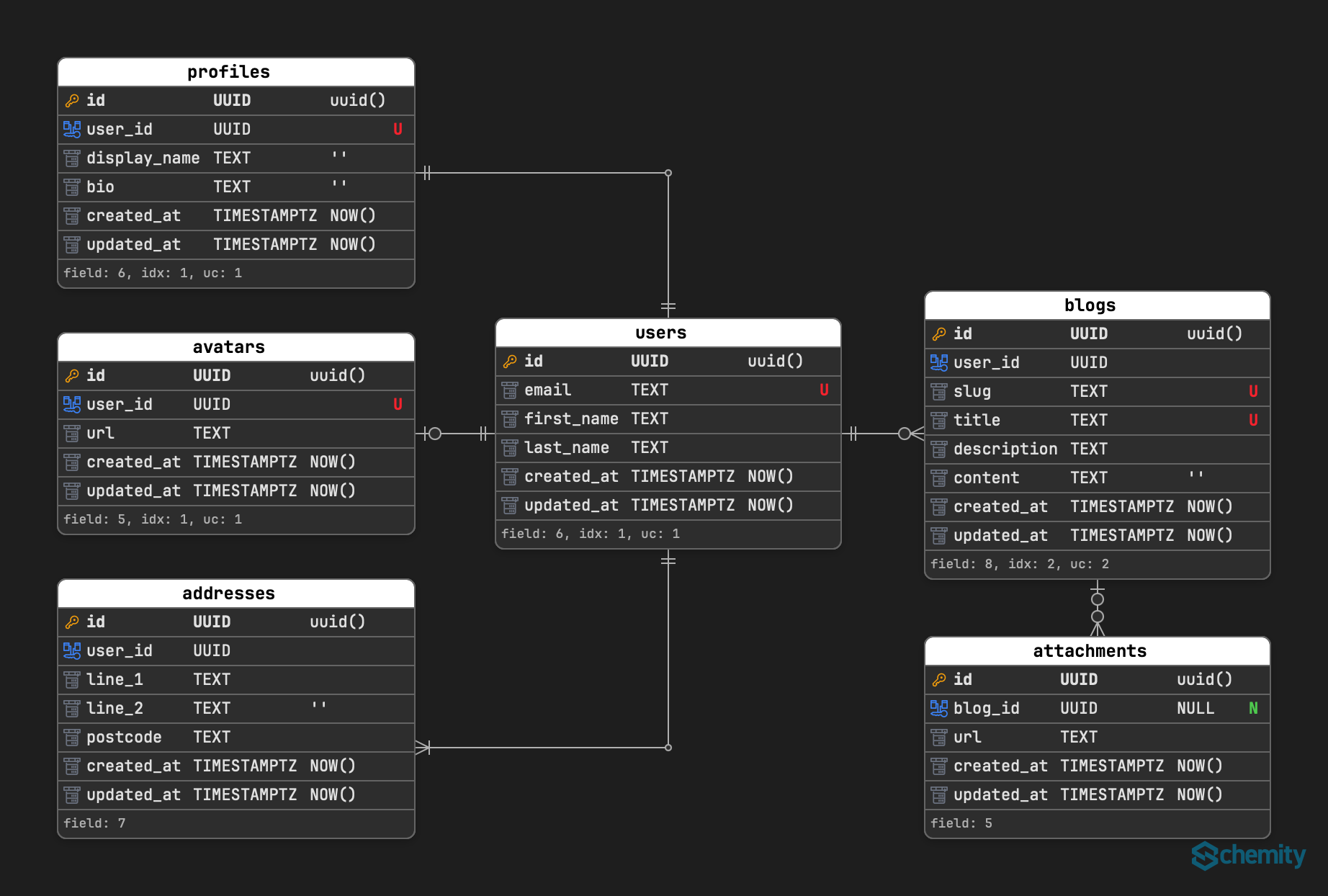
1. users and profiles - ||——||
A user must always have exactly one profile. A profile must always belong to exactly one user.
[users] ||——|| [profiles]CREATE TABLE "profiles" (
"id" UUID DEFAULT gen_random_uuid(),
"user_id" UUID NOT NULL,
"display_name" TEXT NOT NULL DEFAULT '',
"bio" TEXT NOT NULL DEFAULT '',
"created_at" TIMESTAMPTZ NOT NULL DEFAULT CURRENT_TIMESTAMP,
"updated_at" TIMESTAMPTZ NOT NULL DEFAULT CURRENT_TIMESTAMP
);
ALTER TABLE "profiles" ADD CONSTRAINT "profiles_pkey" PRIMARY KEY ("id");
ALTER TABLE "profiles" ADD CONSTRAINT "profiles_user_id_key" UNIQUE ("user_id");
ALTER TABLE "profiles" ADD CONSTRAINT "profiles_user_id_fkey" FOREIGN KEY ("user_id") REFERENCES "users" ("id");NOT NULLenforces that a profile must belong to a userUNIQUEenforces that a user can have at most one profile- “A user must have a profile” is not enforced by SQL
2. users and avatars - ||——o|
A user can have zero or one avatar. If an avatar exists, it must belong to exactly one user.
[users] ||——o| [avatars]CREATE TABLE "avatars" (
"id" UUID DEFAULT gen_random_uuid(),
"user_id" UUID NOT NULL,
"url" TEXT NOT NULL,
"created_at" TIMESTAMPTZ NOT NULL DEFAULT CURRENT_TIMESTAMP,
"updated_at" TIMESTAMPTZ NOT NULL DEFAULT CURRENT_TIMESTAMP
);
ALTER TABLE "avatars" ADD CONSTRAINT "avatars_pkey" PRIMARY KEY ("id");
ALTER TABLE "avatars" ADD CONSTRAINT "avatars_user_id_key" UNIQUE ("user_id");
ALTER TABLE "avatars" ADD CONSTRAINT "avatars_user_id_fkey" FOREIGN KEY ("user_id") REFERENCES "users" ("id");NOT NULLenforces the avatar must belong to a userUNIQUEstill enforces at most one avatar per user- Note: in SQL,
NULLvalues are not considered equal, so multipleNULLvalues are allowed even with aUNIQUEconstraint
3. users and blogs - ||——o<
A user can have zero or many blogs. A blog must belong to exactly one user.
[users] ||——o< [blogs]CREATE TABLE "blogs" (
"id" UUID DEFAULT gen_random_uuid(),
"user_id" UUID NOT NULL,
"slug" TEXT NOT NULL,
"title" TEXT NOT NULL,
"description" TEXT NOT NULL,
"content" TEXT NOT NULL DEFAULT '',
"created_at" TIMESTAMPTZ NOT NULL DEFAULT CURRENT_TIMESTAMP,
"updated_at" TIMESTAMPTZ NOT NULL DEFAULT CURRENT_TIMESTAMP
);
ALTER TABLE "blogs" ADD CONSTRAINT "blogs_pkey" PRIMARY KEY ("id");
ALTER TABLE "blogs" ADD CONSTRAINT "blogs_slug_key" UNIQUE ("slug");
ALTER TABLE "blogs" ADD CONSTRAINT "blogs_title_key" UNIQUE ("title");
ALTER TABLE "blogs" ADD CONSTRAINT "blogs_user_id_fkey" FOREIGN KEY ("user_id") REFERENCES "users" ("id");NOT NULLenforces that every blog must have an owner- No
UNIQUEbecause one user can have many blogs - This is the most common pattern in relational schemas
4. users and addresses - ||——|<
A user must have at least one address. An address must belong to exactly one user.
[users] ||——|< [addresses]CREATE TABLE "addresses" (
"id" UUID DEFAULT gen_random_uuid(),
"user_id" UUID NOT NULL,
"line_1" TEXT NOT NULL,
"line_2" TEXT NOT NULL DEFAULT '',
"postcode" TEXT NOT NULL,
"created_at" TIMESTAMPTZ NOT NULL DEFAULT CURRENT_TIMESTAMP,
"updated_at" TIMESTAMPTZ NOT NULL DEFAULT CURRENT_TIMESTAMP
);
ALTER TABLE "addresses" ADD CONSTRAINT "addresses_pkey" PRIMARY KEY ("id");
ALTER TABLE "addresses" ADD CONSTRAINT "addresses_user_id_fkey" FOREIGN KEY ("user_id") REFERENCES "users" ("id");NOT NULLenforces that every address must belong to a user- “A user must have at least one address” is not enforced by SQL
5. blogs and attachments - |o——o<
An attachment can optionally belong to a blog. A blog can have zero or many attachments.
[blogs] |o——o< [attachments]CREATE TABLE "attachments" (
"id" UUID DEFAULT gen_random_uuid(),
"blog_id" UUID DEFAULT NULL,
"url" TEXT NOT NULL,
"created_at" TIMESTAMPTZ NOT NULL DEFAULT CURRENT_TIMESTAMP,
"updated_at" TIMESTAMPTZ NOT NULL DEFAULT CURRENT_TIMESTAMP
);
ALTER TABLE "attachments" ADD CONSTRAINT "attachments_pkey" PRIMARY KEY ("id");
ALTER TABLE "attachments" ADD CONSTRAINT "attachments_blog_id_fkey" FOREIGN KEY ("blog_id") REFERENCES "blogs" ("id");|onear blogs = FK is nullable, an attachment can exist without a blog- This is the nullable FK case that most tutorials never explain
The Full Mapping Table
| Notation | Side | FK nullable? | UNIQUE? | Reference status |
|---|---|---|---|---|
⎮⎮ | Parent (left) | No | — | NOT NULL REFERENCES |
⎮o | Parent (left) | Yes | — | NULL REFERENCES |
⎮⎮ | Child (right, 1:1) | — | Yes | — |
o⎮ | Child (right, 1:1) | — | Yes | — |
o< | Child (right) | — | No | — |
⎮< | Child (right) | — | No | — |
The Gap: What SQL Cannot Enforce
Here is the part that most tutorials never tell you.
Two of the six notation cases produce identical SQL but mean different things:
| Notation | Meaning | Reference status |
|---|---|---|
o< | Zero or more children | NOT NULL REFERENCES |
⎮< | One or more children | NOT NULL REFERENCES |
The SQL is the same. The |< minimum of one is purely a business rule. SQL has no constraint that says “this parent must have at least one child row.”
Similarly, ||——|| (user must have exactly one profile) is only half-enforced. The FK NOT NULL UNIQUE ensures every profile has a user and each user has at most one profile. But nothing in SQL prevents you from creating a user with no profile at all.
The unenforced cases
| Notation | What SQL enforces | What SQL cannot enforce |
|---|---|---|
⎮⎮——⎮⎮ | Profile must have a user. At most one profile per user. | User must have a profile. |
⎮⎮——⎮< | Address must have a user. | User must have at least one address. |
In both cases, the gap must be handled at the application level. This is intentional and correct. (The rules SQL can enforce - like enumerated value sets in check constraints - deserve to be visible in your diagram too; see Your ERD is hiding your domain model.)
Why this gap exists by design
This is not a flaw in crow’s foot notation. It is a deliberate design decision.
Carlis and Maguire, in their book Mastering Data Modeling (Addison-Wesley, 2001), argue explicitly against capturing minimum degree constraints on a data model diagram. Their reasoning is direct: minimum degree constraints “are so often false or are a function of processing” rather than a true property of the data itself.
They give a concrete example: a hospital clerk reports that “every patient has at least one diagnosis code.” This looks like a valid minimum constraint. But it is false - a patient admitted to the emergency room has no diagnosis code yet. The constraint only holds at a specific stage of the process, not at all times. It is a processing rule, not a data rule.
The same logic applies to your schema. “A user must have at least one address” is almost certainly a processing rule - enforced when a user checks out, or when an order is submitted, not at the moment the user row is created. SQL enforcing it at the database level would break every user registration flow that creates the user first and collects the address later.
Summary
| Concept | Key takeaway |
|---|---|
| Convention | Parent on the left, child on the right |
| Reading rule | Symbols describe the entity they touch, read outward in pairs |
⎮o vs ⎮⎮ on parent | Nullable FK vs NOT NULL FK |
o⎮ vs ⎮⎮ on child | Identical SQL, only intent differs both 1:1 |
o< vs ⎮< on child | Identical SQL, only intent differs both 1:N |
| The gap | Minimum degree constraints are often processing rules, not data rules |
Crow’s foot notation is more expressive than SQL. That is not a flaw, it is by design. The notation captures business intent. SQL enforces what it can. Your application handles the rest.
To watch these mappings drive a real design, see Multi-Tenant RBAC Schema Design for the identity half, and Roles and Permissions Table Design for the two N:N junction tables - where the choice between a composite primary key and a surrogate id is made twice, differently, and the notation is what makes the difference visible.
References
- Everest, G. C. (1976). “Basic Data Structure Models Explained with a Common Example.” Proceedings of the Fifth Texas Conference on Computing Systems, pages 39-46. IEEE Computer Society.
- Carlis, J. and Maguire, J. (2001). Mastering Data Modeling: A User-Driven Approach. Addison-Wesley.
Frequently asked questions
What does crow's foot notation mean?
Crow's foot notation encodes each end of a relationship line with two symbols: cardinality (one bar = one, crow's foot = many) and optionality (circle = zero possible, bar = at least one required). Reading both symbols on both ends gives you the full rule, which maps directly to SQL constraints.
What is the difference between a 1:N and an N:N relationship?
In a 1:N relationship, the child table holds a foreign key pointing at the parent - one parent row, many child rows. An N:N relationship cannot be stored directly; it requires a junction table with two foreign keys, turning one N:N into two 1:N relationships.
What does the circle (zero) mean in an ERD?
The circle means the zero case is allowed. On the many side, it means a parent can have no children. On the one side, it means the foreign key is nullable - a child can exist without a parent. If the diagram shows a bar instead, the SQL must enforce NOT NULL on that foreign key.